Saving a threatened limb can need metabolic optimisation, wound care, restored perfusion, infection control, offloading and sometimes surgery, in quick succession. No single clinician holds all of these skills, so outcomes depend less on individual excellence than on whether those skills are organised to act together. In one systematic review, 31 of 33 studies reported fewer major amputations after a multidisciplinary team was introduced. The evidence is observational, and the module teaches it at that strength.
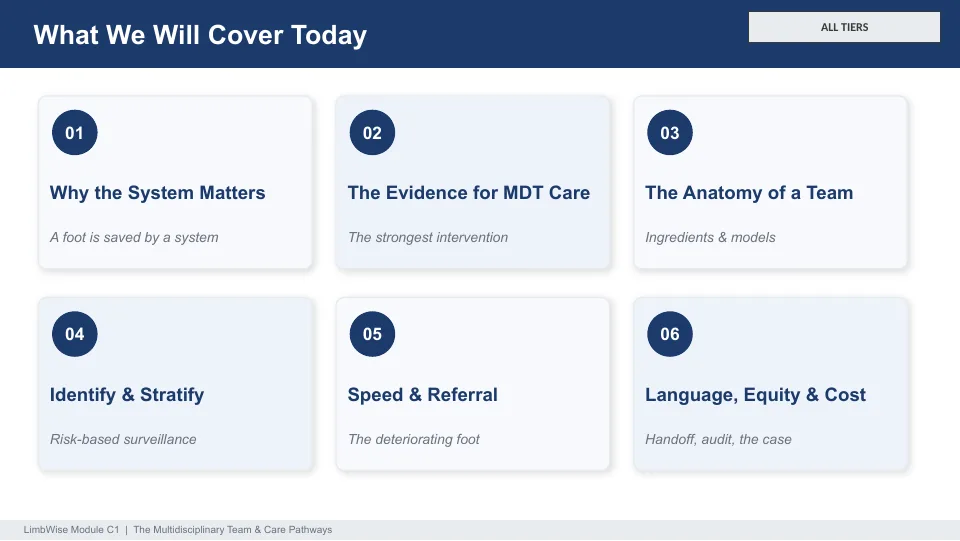
It teaches the four ingredients shared by effective teams, the core disciplines and what each contributes, and the toe-and-flow model at basic, intermediate and centre-of-excellence level. It sets IWGDF risk categories against screening intervals, lists the triggers that make a deteriorating foot an emergency rather than a routine appointment, and shows why a SINBAD description with perfusion and infection status moves a referral faster. Advanced content covers audit, equity and the economic case for commissioners.
Content is tiered at Foundation, Core and Advanced level, with two algorithms and three case vignettes. You receive the Teaching Document, the Evidence Base, the slide deck, a narrated video and an audio overview.